An interesting question to consider is the point at which a man realizes he is the most important man in the world. And if he firmly believes that no other man, woman, or child in the entire world is above him, how would he use that power? Because maybe in his understanding this is the ultimate power. The world is in the palm of his hand, or at least, that is what he believes.
It is a strange thing to imagine. But when we look at people who have spent their lives in positions of absolute power, it becomes difficult to separate this idea from reality.
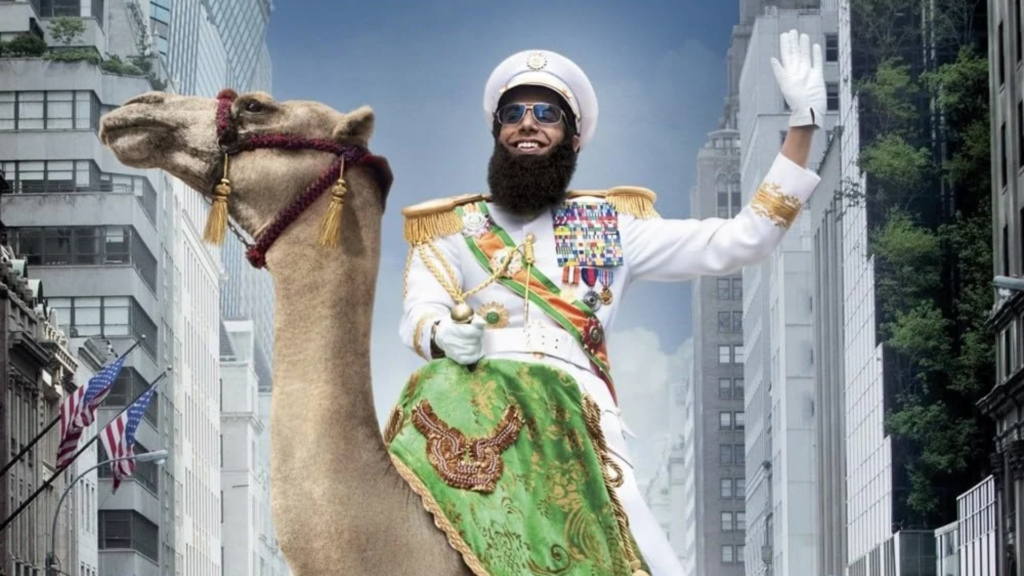
In The Dictator (2012), directed by Larry Charles and co-written by Sacha Baron Cohen, Alec Berg, David Mandel, and Jeff Schaffer, Cohen plays Admiral General Aladeen, the ruler of the fictional country of Wadiya. He is a man who executes people for disagreeing with him, refuses to sell his country’s oil, and is developing nuclear weapons to attack Israel. He is also someone who believes that his own name should be enough to describe the world around him.

The film takes this obsession with power and turns it into a comedy, but the more we look at Aladeen, the more familiar he begins to feel. This is what makes the film’s satire work.
Aladeen is ridiculous, but he is not entirely removed from the world we know. Sacha Baron Cohen has spoken about how Muammar Gaddafi inspired the character, alongside other dictators such as Kim Jong-il and Saddam Hussein. These were people whose behaviour often seemed so exaggerated that it was difficult to believe they were real. Gaddafi, for instance, had an all-female security force, while Turkmenistan’s Saparmurat Niyazov changed the names of the months and days of the week to reflect himself and his family.
The film takes these real-life excesses and brings them together in Aladeen. But what is astonishing is that his obsession with himself does not stop at the way he looks or the way he treats people. It extends to the world he wants to create around himself.

One of the funniest examples of this is when Aladeen changes the Wadiyan dictionary. He replaces hundreds of words with his own name, so that even the words “positive” and “negative” become “Aladeen.” A doctor tells a patient that he is HIV-Aladeen, leaving him unable to understand whether he has received good news or bad news.
It is an absurd joke. But I think there is something quite revealing about it. Aladeen does not simply want to be the person who makes decisions for his country. He wants to be the person through whom his people understand everything. Even language, something that belongs to everyone, becomes his somehow. The world is no longer allowed to exist outside his own understanding of it.
And this is where the film’s satire of religion becomes gripping.
Aladeen is not a religious leader, nor is the film directly satirising Islam. In an interview with Terry Gross, Cohen explained that Aladeen’s religion is himself. He has turned himself into a demigod. The film deliberately creates a fictional country and a fictional leader, drawing from different dictatorships rather than representing a particular religion or culture.
What I find fascinating about this is how closely Aladeen’s relationship with power resembles the kind of devotion he demands from his people. He does not expect them to just obey him. He expects them to believe in him. His authority is treated as something that cannot be questioned, even when the things he does are cruel or preposterous. His name becomes a part of everyday life, his image is everywhere, and his people are expected to accept his rule as though it were the natural order of things.

There is a difference between believing in something and being made to believe in it. And Aladeen’s world is built around the latter.
The film’s understanding of democracy becomes particularly enthralling when Aladeen arrives in America. For the first time, he finds himself in a place where he is no longer the most powerful person in the room. He encounters Zoey, a woman who runs a cooperative grocery store and believes in equality, freedom, and the rights of ordinary people. Her understanding of the world is almost entirely different from his.
Aladeen cannot understand why people should be allowed to disagree with their leaders, why everyone should have the right to vote, or why women should be allowed to make decisions for themselves. He has spent his entire life believing that his decisions are the only ones that matter. Sharing power is not something he understands, let alone something he wants to do.
But The Dictator does not simply make America the opposite of Wadiya. It takes Aladeen to America, and that is where the film’s satire begins to get a little closer to home.

One of the film’s most provocative moments comes when Aladeen stands before an American audience and asks them to imagine their country under a dictatorship.
“Imagine if America was a dictatorship.” He goes on to describe a country where one per cent of the population controls most of the wealth, where the government cuts taxes for its wealthy friends and bails them out when they lose money, while the poor are left to fend for themselves. He talks about a media that appears free but is controlled by one person and his family, elections that are rigged, torture and wars justified through lies. He even describes a country where prisons are filled with one particular racial group, while people are made to fear the very policies that work against them.
The irony is that Aladeen is describing the kind of country he himself rules. But when he says these things about America, the joke becomes a little uncomfortable. Some of what he describes does not sound entirely unfamiliar though.
This is where the film becomes more than a comedy about a fictional dictator. It begins to question the distance between what a country claims to stand for and what actually happens within it. America prides itself on freedom, but Aladeen’s speech points to how easily that freedom can become selective. The wealthy are protected, the poor are ignored, and the media can serve those in power while continuing to appear independent. People can believe they are free even when the decisions being made around them do little to serve their interests.
The film is not saying that democracy and dictatorship are the same. But it does ask what happens when a democracy begins to accept the very things it claims to oppose.
What makes the speech even more interesting is that it comes from Aladeen. He has not suddenly become a thoughtful political observer. He is still the same man who believes he is entitled to everything. And yet, for a moment, he manages to expose the contradictions of a country that considers itself morally superior to him and everyone else.
But Aladeen’s words do not come from somebody who has changed.

When he returns to Wadiya and agrees to establish democracy, he wins the election with 98.8 per cent of the vote through intimidation and unfair means. The country is now supposedly democratic, or, one could say, pseudo-democratic, but the same man remains in power. The election has given Aladeen another way to hold on to it.
This is what makes the ending so telling. He has agreed to democracy, but he has not changed his understanding of power. He still sees Wadiya as something that belongs to him. The people may have the right to vote now, but their vote has not really changed who gets to rule them.
The problem with Aladeen is not only that he is a dictator. It is that he cannot imagine a world in which he is not at its centre. Even when the structure of his government changes, that belief remains.
Wadiya may be fictional, but the people who inspired Aladeen were not.
And that is what makes the film difficult to dismiss. We laugh at a man who believes that everything should revolve around him, but the world outside the film has given us enough reasons to recognise that kind of power in the real world.