
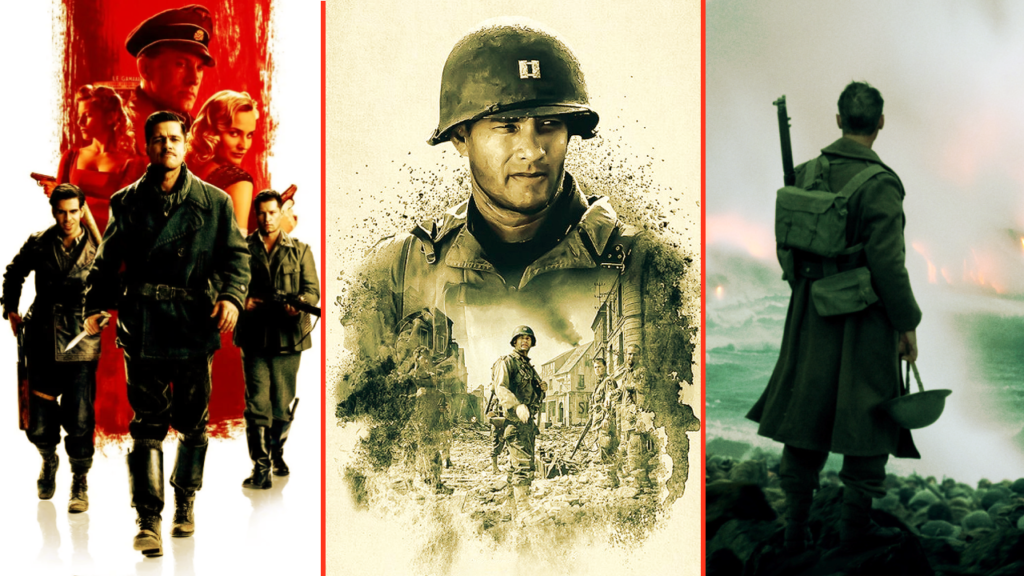
War in itself, as a word, is pretty sensitive to begin with. Even without talking about a specific war, the mention of war tells us that people have lost their lives to it. More than that, people have lost their families, their homes, and their loved ones. Cinema is sensitive too, in its own way. The kind of sensitivity may be different, but largely its sole aim is to make the viewer feel something, anything.
And when cinema chooses to tell stories around something as large and devastating as war, there is already a certain weight to what it is trying to portray.
World War II carries that weight more than most. It wasn’t just a conflict within different states of one single country. It was a war between different countries altogether, between the Allied forces and the Axis powers. It was also understood, by the countries involved, as a war that would decide the fate of the world moving forward. And then there was Adolf Hitler, who almost became the real-life version of the villain that cinema usually has to imagine. The horrifying, monstrous villain that one generally thinks is made up for films was, in this case, a real person. And for the Allies, which included the US, the ending of the war came with a certain sense of assurance that good really could triumph over evil, no matter how strong or monstrous that evil was.
Maybe that is also why World War II has become Hollywood’s somewhat favourite war to dramatise.
There are so many films about it, but what is more interesting is how differently those films can treat the same war. Because a World War II film does not necessarily have to be a war film in the traditional sense of the word. The war can be the entire story, or it can simply be the world in which another story is taking place.
A film can be a mission. It can be a heist. It can be a romance. It can be a thriller. It can be about survival. It can be about a soldier coming home. It can even be about people who barely have anything to do with the battlefield.
Inglourious Basterds (2009), The Great Escape (1963) and The Dirty Dozen (1967), for instance, use the war almost like an adventure or mission-based setting. There are specific objectives, specific people who need to be reached or escaped, and a very clear sense of danger because of the world surrounding them. The Imitation Game (2014) and Allied (2016) take the same historical period and move towards espionage, secrecy and paranoia. The actual battle is not necessarily what drives the story. The tension comes from what people know, what they don’t know and what they are hiding.
Then there are films like Casablanca (1942) and The English Patient (1996), where the war becomes the reason people are separated, displaced or forced into situations they otherwise would never have experienced. Casablanca is remembered largely for the love story between Humphrey Bogart and Ingrid Bergman’s characters, but the war is always present around them. The famous scene where French patrons sing their national anthem over German soldiers is a reminder that even when the film is talking about love, the larger conflict cannot completely disappear.
And then there are films that take us straight into survival.
Dunkirk (2017), Saving Private Ryan (1998), Fury (2014), Hacksaw Ridge (2016), Greyhound (2020), Midway (2019) and Memphis Belle (1990) all approach the war differently, but there is something common between them. They put the viewer closer to the experience of being inside the conflict. The fear of being attacked, the uncertainty of getting out alive, the physical exhaustion, and the constant possibility of death become more important than explaining the war itself.
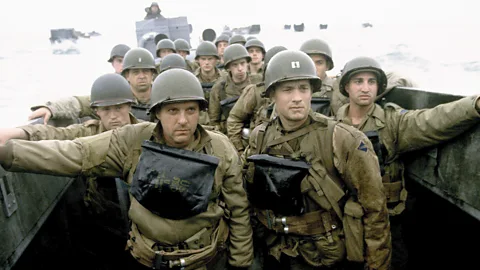
Saving Private Ryan and The Thin Red Line, both released in 1998, are a good example of how even two films dealing with soldiers and combat can have completely different intentions. Spielberg’s film is more patriotic and sentimental, while Terrence Malick’s is more poetic and philosophical. One makes us look at the sacrifice of soldiers through a very direct emotional lens, while the other seems more interested in what war does to the human mind and the way people understand life and death.
The war is the same. The story is not.
And this is probably the biggest reason World War II works so well as a cinematic setting. It is a macro-setting that instantly raises the stakes of whatever story you put inside it.
Take something as ordinary as a cinema theatre. On its own, a cinema theatre is just a place where people watch films. Put it inside Nazi-occupied Europe and make it the centre of Inglourious Basterds, and suddenly it becomes something much larger. The same can happen with a submarine, a battlefield, a home, a prison camp or even a relationship. The war brings a larger consequence to whatever is already happening within that smaller story, and amplifies them to the extreme.
Hollywood’s usual business model is built around audiences understanding what they are watching and wanting to watch it. There are genres and structures that have worked for years. There are heroes, villains, missions, romances and conflicts that audiences recognise. World War II gives filmmakers the freedom to take those familiar structures and place them inside a backdrop that already comes with enormous stakes.
It is a setting that does not have to be invented. History is the ultimate public domain IP (Intellectual Property).
The present and future is always going to have World War II. The war is over, and that means filmmakers can keep going back into it, picking out events, people and moments that they want to dramatise. There is already an inherent understanding of what the war meant to the people involved. We learn about it in school. We see its consequences in history. It affected almost the entire world. Even someone who does not know every battle or every name knows what World War II was.
That makes it a strange kind of cinematic treasure.
A filmmaker doesn’t have to explain an entirely new world before beginning the story. They can enter one that already exists in people’s minds. This is also why the films made about World War II have changed so much over the years.
There are stories that were interested in what the war did to people. The Best Years of Our Lives, released in 1946, is one of the clearest examples. It follows three soldiers returning to America and trying to get back to their lives. The war is no longer happening around them, but it has not really ended for them. The film looks at how difficult it can be to return to an ordinary life after experiencing something that is anything but ordinary.
This idea of the war continuing after the war itself has appeared in cinema again and again. The battlefield may disappear, but the people who were on it still have to live with what happened there.

That is where films like Schindler’s List (1993) also become important. It does not use World War II simply as a backdrop for action or adventure. It goes into the Holocaust and the lives of people whose entire existence was changed by it. The Diary of Anne Frank (1959) approaches the same period through the life of a young girl. Judgment at Nuremberg (1961) takes yet another direction. Instead of asking what happened during the war, it asks what happens when people have to confront what was done after it. The war becomes the beginning of another question rather than the end of the story.
And as time moved further away from World War II, cinema also began to look at the people who had traditionally been presented simply as the enemy.
Letters from Iwo Jima (2006) is particularly interesting in this regard. The film looks at the same battle that American audiences had already seen from the other side and gives the Japanese soldiers their own fears, relationships and hopes. They are still part of the opposing army, but they are no longer simply an opposing force. They are people.
That is something modern cinema has become increasingly interested in. We are obsessed with anti-heroes, grey areas and psychological complexity. Clear-cut good and evil can sometimes feel too simple and straightforward for contemporary storytelling. Yet, World War II remains one of the few historical settings where Hollywood can return to a conflict that was, at its broadest level, understood in very clear moral terms, while still finding grey areas within the people who lived through it.
And maybe that is what makes World War II such a useful setting for Hollywood. The war is big enough to make almost anything feel important, but the story within it can remain incredibly small. A romance can be about two people. A war film can be about one mission. A historical drama can be about one family. A film about the Holocaust can be about one person trying to save another. The scale of World War II allows all of these stories to exist together.
Maybe that is why Hollywood keeps returning to it.
We know how the war ended. We know the broad history. We know who won. Yet, cinema keeps finding something new to ask within those years. Sometimes we are on the battlefield. Sometimes we are waiting at home. Sometimes we are trying to escape. Sometimes we fall in love. Sometimes we are looking at the enemy. And sometimes, we are simply trying to understand what the war felt like for the people who lived through it, even if, at the time, they were on the opposing side of the line.
The war stays the same. The perspective keeps changing. And that is what keeps the subject of World War II alive in Hollywood, not the war as a single story, but the thousands of stories that can exist within it.
Read More:
- How Do Independent Films Survive? The Economics Behind the Movies
- Batwara 1947: How Hindi Cinema Kept Remembering The Scar Of Partition
- Batwara 1947: How Hindi Cinema Kept Remembering The Scar Of PartitionTHE SEED OF THE SACRED FIG: When Politics Enters the Home
- How a Film Is Born: The Journey from an Idea to the Big Screen
- Egyptian Cinema: Why Cairo Became the Hollywood of the Middle East