Cinema has a strange relationship with locations. Sometimes a location is simply a location. And sometimes, it becomes something else entirely once a camera enters it. Morocco has been doing this for Hollywood for years.
Morocco has quietly become one of those places where filmmakers can make the world look like almost anything, they want it to be. A desert can become another planet. An old city can become Jerusalem. A street in Marrakech can become a city somewhere in the Middle East. A small village can suddenly belong to a completely different century.
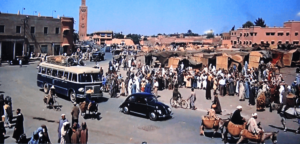
This is why the country has been used for some of the biggest films from around the world. Alfred Hitchcock’s The Man Who Knew Too Much (1956), Martin Scorsese’s The Last Temptation of Christ (1988) and Kundun (1997), David Lean’s Lawrence of Arabia (1962), Ridley Scott’s Kingdom of Heaven (2005), Alejandro González Iñárritu’s Babel (2006), and Mission: Impossible: Rogue Nation (2015) are only some of the films out of many that have been shot here. And what is interesting is that many of them were not really trying to show Morocco. They were using Morocco to show somewhere else.
Maybe that is where the relationship between Hollywood and Morocco really begins.
The country simply has a lot to offer. There are deserts that seem to have no end, mountains, old cities, narrow streets, markets, qasbahs, palm trees and coastal areas. The landscape keeps changing. You can leave one kind of place and find something completely different not too far away.
For a filmmaker, that can be everything. That can mean allocating a large part of the production to one location, where one can shoot for multiple requirements.
There is also something about Morocco that feels difficult to recreate. Its old cities and markets have not been preserved only to look old. They are still lived in. The souks are still full of people, the streets are still being used and the architecture still belongs to everyday life. So, when a camera enters these places, it does not always feel like a set trying to convince us that it is real. It already is.
And then there is Ouarzazate.
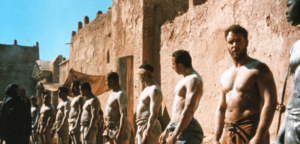
Often called the “Hollywood of Africa,” Ouarzazate has become one of the most important filmmaking centres in the country. It is also home to Atlas Studios, one of the world’s largest film studios by land area. The studio has been used for productions like Gladiator, The Mummy, Lawrence of Arabia, Alexander, Babel, and Kingdom of Heaven.
The interesting thing about Atlas Studios is not just its size. It is the fact that so many different worlds have existed in the same place. Roman settings, Egyptian structures, ancient cities and other large sets have been built there. One film can use a space to tell one story, and another film can come along and make it something completely different.
Maybe that is what sets are supposed to do anyway: take the shape of the film’s requirements.
But Ouarzazate does not need its studios to make it cinematic. The landscape around it does enough on its own. The desert, the mountains and the dry open land have become some of the most recognisable filming locations in Morocco.
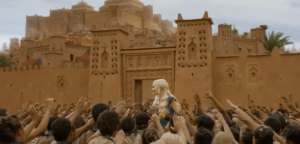
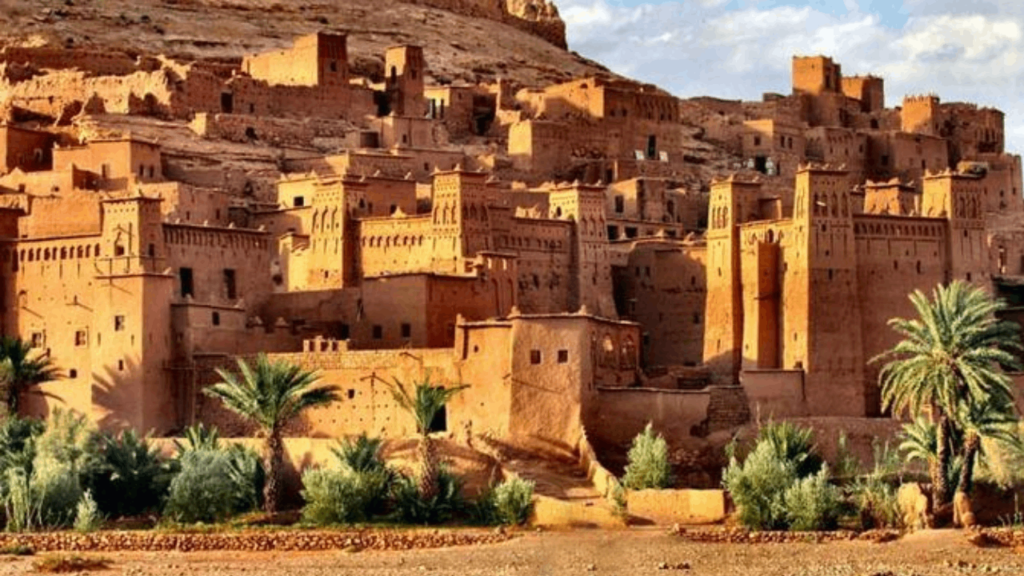
Not far from the city is Aït Benhaddou, another place that filmmakers have returned to again and again. The old fortified village, with its mud-brick buildings and narrow paths, has appeared in Gladiator, Lawrence of Arabia, The Mummy, Kundun and Game of Thrones. It is easy to understand why. Some places already look like they belong to another time. You do not have to build much around them. You just have to frame them correctly.
But looking good is not enough to make a country a favourite shooting destination. Films need people, equipment, permissions, production services and an entire system that can support them. Morocco has developed all of this over time because international productions have kept coming back.
Local crews have become familiar with working on large productions. Studios and production services have grown around the industry. And for filmmakers, this means they are not simply arriving in a beautiful country and figuring everything out from scratch.
There is also the cost. Filmmaking is expensive, and sometimes the biggest difference between two locations is not what they look like, but what they cost. Morocco can offer international productions a more affordable way of shooting while still giving them large locations, experienced crews and established studios. The government has also supported international productions through incentives and assistance with filming.
Then there is something as simple as sunlight.
Morocco gets long hours of bright natural light, especially around its desert regions. For productions that need to spend a lot of time outdoors, that can make all the difference. Sometimes cinema depends on very complicated things. And sometimes, it is just about having the right light for as long as possible.
What makes Morocco even more useful is that it does not always have to look like Morocco. The film Spy Game used Casablanca to represent Beirut. Similarly, the film Mosul used Marrakech to recreate Mosul, the Iraqi city where the story is set.
Other productions have used Moroccan cities and landscapes to represent places across the world.
And this is probably one of the most interesting things about filming there. A place does not necessarily become important to cinema because of what it is. Sometimes it becomes important because of what it can pretend to be.
Morocco has been able to do that splendidly.
Marrakech has also become important to the world of cinema in another way. The Marrakech International Film Festival, established in 2001, has brought filmmakers and film lovers from different parts of the world together. So, the country’s relationship with cinema is not only about providing a backdrop. It has also become a place where films and filmmakers meet.
There is something almost ironic about Morocco’s position in cinema. It has been used to represent so many other places, yet it is the country’s own identity that made this possible in the first place. Its deserts are its deserts. Its old cities are its old cities. Its mountains are its mountains. But once they enter a film, they can become anything.
And maybe that is why Hollywood keeps coming back.
Not because Morocco looks like Hollywood. Not because it tries to become somewhere else. But because it gives filmmakers the freedom to make it somewhere else.=
A location becomes special when it stops being just a location, and becomes something more, a contribution to the story the film is telling. And Morocco seems to have crossed that line a long time ago.
Read More:
- Conclave: Faith and Power Collide Behind Closed Doors
- Stop-Motion Animation and Guillermo del Toro’s Pinocchio
- The Evolution of Indian Cinema: From Satyajit Ray to Anurag Kashyap
- How Cinema Helped Fight Racism: A Look at Films That Changed Society
- The Best World War 2 Films: A Cinematic Journey Through History