
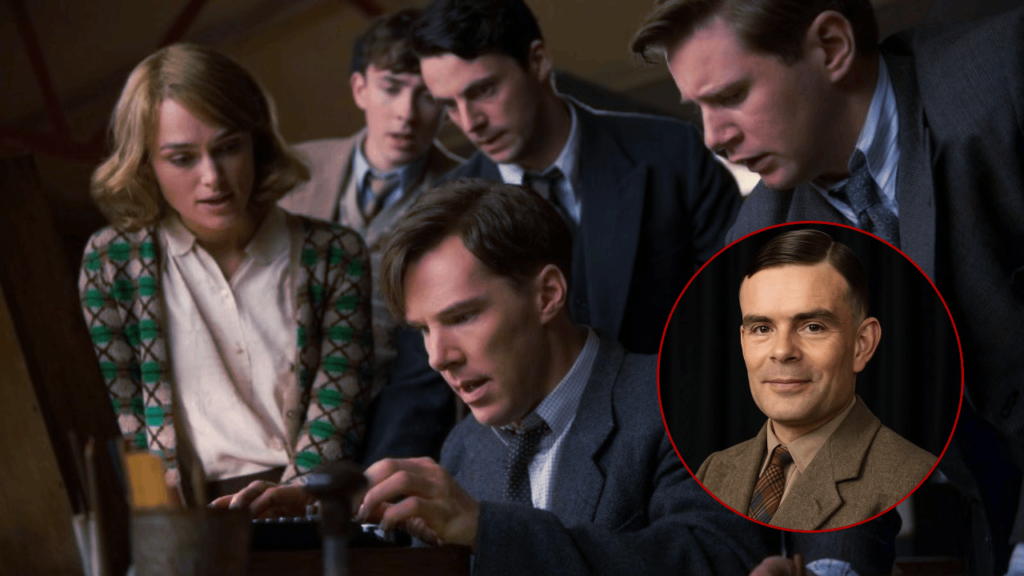
Fighting a war together as a family means putting aside all your differences. No matter how big a conflict you are having within your own family, there is something bigger happening outside. Something that needs to be won together. So you fight together.
But what you don’t do is end your own conflict. You just set it aside for later.
And when later comes, you engage knowing that everyone had fought together. Knowing that the more important thing was accomplished together. Knowing that sacrifices were made. Knowing that the person you are making suffer now is the same person without whom you might not have won the war.
That is what astounds me.
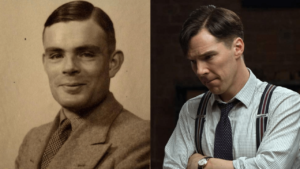
Released in 2014 and directed by Morten Tyldum, The Imitation Game is based on the book Alan Turing: The Enigma by Andrew Hodges. It tells the story of Alan Turing, a mathematician, computer scientist, logician, cryptanalyst, philosopher and theoretical biologist, whose work became pivotal to the British war effort during the Second World War. He is the man who played a crucial role in cracking intercepted messages that enabled the Allies to defeat the Axis powers.
But the film does not begin with a hero. It begins with a man being questioned. A man who is difficult to understand. A man who does not fit easily into the boxes people have already made for him. And slowly, through the film, we begin to understand why.
Turing joins the British effort to decode the German Enigma machine at a time when the Allies were losing the war. These were frightening times. Britain was starving, and German U-boats were sinking ships carrying desperately needed supplies.
At the centre of all of this was the Enigma machine, one of the most sophisticated encryption devices of its time. The Germans used it for their major communications, changing its settings every day at midnight. That meant the team working to decode it had a narrow window in which to intercept and understand the messages before the entire system changed and they had to begin again.
Turing understood what they were up against.
“I like solving problems, Commander, and Enigma is the most difficult problem in the world.”
And he was right.
He was not fighting the war with a gun. He was fighting it with a machine he was trying to build, numbers he was trying to understand, and a mind that refused to work in the way everyone else’s did.
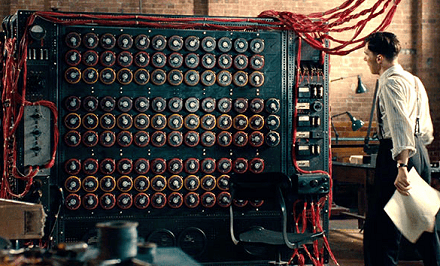
The film captures the entirety of what Turing and his team did, quite vividly, when Turing describes the war from his perspective, “Victories that would not have been possible without the intelligence that we supplied. And people talk about the war as this epic battle between civilisations. Freedom versus tyranny. Democracy versus Nazism. Armies of millions bleeding into the ground. Fleets of ships weighing down the oceans. Planes dropping bombs from the sky until they obliterated the sun itself. The war wasn’t like that for us. For us, it was just half a dozen crossword enthusiasts in a tiny village in the south of England.”
And that is one of the most interesting things about The Imitation Game. It takes something as enormous as a world war and brings it down to a handful of people sitting in a room, trying to solve an impossible problem.
He and everyone else had to keep everything a secret even after the war because of the classification of what they had done and the possibility that, in the future, this unknown weapon might be needed again. The work he had done, the information he had seen, the role he had played in helping the Allies win, all had to remain a secret. He could not tell the world anything about what he had done; even the mention of it would have meant treason.=
The true nationalist, in that sense, is not always the person standing in front of a flag. Sometimes it is the person quietly giving everything they have to a country that may never even know what they gave.
And Britain did fall short of recognising him.
After the war, the country that had needed his mind turned around and punished him for the person he was. He was exceptionally extraordinary, the smartest man in most rooms he entered, and yet, he spent much of his life being treated as though being different was a defect.
At the time, homosexuality was illegal in Britain, and Turing was charged and convicted with gross indecency. He was given a choice between imprisonment and chemical castration. He chose the latter because he wanted to continue his work and hated any kind of confinement.
Think about that for a moment.
A man who had helped his country survive a war was now being punished by that same country for being himself. He was different, uniquely so, with a brilliant mind that had worked for the British government. And yet, he was punished for being different.
And, at just 41 years old, Alan Turing died by suicide.
It is impossible to look at his story without feeling the cruelty of the contradiction. During the war, his difference was useful. His mind was useful. His inability to think like everyone else was precisely what allowed him to think of something nobody else could. But once the war was over, the same world that had benefited from his difference wanted him to conform to it. The undeniable irony of the situation is bleak, dismal, and heartbreaking.
That is the tragedy.
The film does an incredible job of displaying his entire life, from when he was a child to his time working on cracking Enigma and finally into the years after the war. Who he was, is beautifully captured. The film feels with him. The camera moves with him. The sound hears him.
And eventually, the film leaves us with a question that Turing asks the police officer during his interrogation, one that perhaps defines the entire story: “So tell me, what am I? Am I a machine? Am I a person? Am I a war hero? Am I a criminal?” The police officer tells him, “I can’t judge you.” When he says that, you don’t feel that he’s saying it because he can’t call him a war hero, because of course he is that, but at the same time, he’s also a person. However, the officer knows he’s not being treated as one by his own fellow comrades. Because, in that moment, he understands the importance of the man sitting in front of him. He is not able to answer only because he finds himself short of judging someone as monumental as Alan Turing.
And I agree with him. Who are we to judge him or put him in a box? All his life, everyone had done exactly that. Everyone had reduced him to one thing or another. A mathematician. A machine. A criminal. A war hero. A homosexual man. A genius. But he was never just one of those things.
He was Alan Turing.
And maybe that is what makes the story hurt even more. He gave the world so much, even if the world failed to give him his own fair share, let alone what he deserved, while he was alive.
It is sad that he is gone. It is sad that what happened happened. It is sad that even when he was a hero, he suffered, and alone. He deserved the world’s happiness, but did not get it. He had to make his own, every day.
There is something almost unbearable about fighting alongside someone as a family, winning the war together, and then turning around and punishing the very person who helped you win it.
The war had ended. The enemy had been defeated. But for Turing, another war had already begun. And this time, it was against the world that he had helped save.
That is what The Imitation Game ultimately leaves behind.
Not just the story of a man who cracked Enigma. Not just the story of a brilliant mathematician or a war hero. It is the story of an extraordinary man who lived in a below-par world, one that was not equipped to understand him. He never got to see what could be. He never got to experience love openly. Never got to be himself openly.
And maybe the last echo the film leaves with you is not one of sadness, but of belief. A belief in oneself, even when you are told that you are different. Even when that difference is looked at with contempt or disgust. Even when the world tries to make you feel like there is something wrong with you simply because you do not fit into what it has decided is normal.
“Sometimes, it is the people who no one imagines anything of who do the things that no one can imagine.”
Alan Turing embodies the image of that line perfectly.
The world simply took too long to understand what it had lost.
Read More:
- When Politics Became Personal: The New Face of Israeli Cinema
- World War II: The Story That Hollywood Never Stops Telling
- What Makes a Film Timeless
- How Do Independent Films Survive? The Economics Behind the Movies
- Batwara 1947: How Hindi Cinema Kept Remembering The Scar Of Partition