Hope is a strange thing. It is easiest to have when life is going well, when tomorrow looks promising, when there is something visible to look forward to. The real test of hope is whether it can survive when everything around you is designed to crush it.
That, to me, is what The Shawshank Redemption, a 1994 American drama film written and directed by Frank Darabont, based on the 1982 Stephen King novella Rita Hayworth and Shawshank Redemption, is about.
On the surface, it is a story about prison, friendship, injustice, and freedom. But underneath it all, it is about finding hope where there is none.
Andy Dufresne is at the centre of that idea. One of the things that always stood out to me about him is that prison never truly changed who he was. People often say prison changes a man. But not Andy. Andy Dufresne was the same man before he got sent to Shawshank, and after. He refused to let the prison define him.
The evidence of this is seen almost immediately. On the first night, a frightened inmate is beaten so badly that he dies. The next morning, everyone is stunned, sure. But only Andy dares ask a simple question, “What was his name?”
Before I knew the rest of the story, for me, in that moment, I could define who he was. Nobody cared about the dead man’s name. To everyone else, he was just another convict. Andy didn’t know what crime he had committed. Maybe, yes, that could have or would have made a difference to some people. But with the facts he had in hand, asking for his name felt the most natural thing to do, and so he did. I mean, if it were a place outside prison, and Andy heard that a stranger had died because of negligence and mistreatment, he would’ve asked the same thing. So, why should that change simply because he’s inside a prison?
That is who Andy is. He never allows Shawshank to take away his humanity.
Red describes him perfectly, “He had a quiet way about him, a walk and a talk that just wasn’t normal around here. He strolled like a man in the park without a care or worry in the world, like he had an invisible coat that would shield him from this place.”
That invisible coat is important. Because Shawshank is not just a prison. It is a place built to kill hope.
The best example of this is Brooks. After spending decades behind bars, he no longer knows how to live outside them. Freedom becomes more frightening than imprisonment itself. As Red explains, “These walls are funny. First you hate them. Then you get used to them. Enough time passes, you get so you depend on them. That’s institutionalized. They send you here for life, and that’s exactly what they take.”
That is Shawshank’s real punishment. Not the walls. Not the bars. Not even the violence. It is the slow death of hope. The gradual conditioning of a person to stop dreaming, stop wanting, and stop believing that life can ever be different. That you could ever get outside of these walls. Yet, Andy somehow resists that fate.
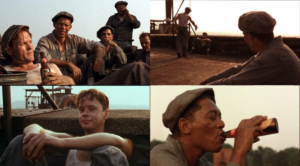
Throughout the film, he keeps creating little moments of freedom. The rooftop beer scene has to be one among many favourites. After helping the guard with a tax problem, Andy secures cold beers for his fellow inmates. Yet he doesn’t drink a single one himself. He simply sits there, smiling, watching his “co-workers” drink as the sun sets behind them. For a brief moment, they aren’t prisoners. They’re just men sharing a beer after an exhausting day’s work. Andy understands something that many people don’t, freedom is not always physical. Sometimes it can even exist in moments.
The same can be said about the library. Most people would’ve given up after receiving rejection after rejection. Andy doesn’t. He writes letters. Then writes again. And again. And again. For six consistent years. I always found that inspiring. If Andy had been outside prison, he would’ve probably approached life the same way. The same way someone keeps attempting a difficult exam, failing, preparing again, and trying once more, believing that one day they will succeed. Andy applies that same persistence to writing letters. Everyone says it is impossible. He keeps going anyway. Eventually, he does get what he wants.

And then comes perhaps the most touching scene in the film. Andy locks himself inside the warden’s office and plays Mozart over the loudspeakers for the entire prison to hear. It is a celebration, not only of achieving something that everyone said couldn’t be done, but also of giving something back to every man trapped inside those walls. For a few minutes, nobody is a prisoner. Everyone simply listens to music.
As Red says, “Those voices soared, higher and farther than anybody in a gray place dared to dream. It was like some beautiful bird flapped into our drab little cage and made those walls dissolve away. And every last man at Shawshank felt free.” Music became freedom. It reminded everyone that there was still a world beyond these bars.
That is what Andy does throughout the film. He keeps reminding people that there is more to life than the walls surrounding them.
This idea becomes even clearer during his conversation with Red about the harmonica. Red tells Andy that he used to play when he was younger but lost interest. It didn’t make much sense in prison anymore. To which Andy responds, “Here’s where it makes the most sense. You need it so you don’t forget that there are places in the world that aren’t made of stone. There’s something inside that they can’t get to, that they can’t touch. That’s yours.. Hope.” Red’s response is immediate, “Hope is a dangerous thing. Hope can drive a man insane.”
And honestly, Red isn’t wrong. For a man serving a life sentence, hope can feel dangerous. It can remind you of everything you’ll never have. It can become painful. But Andy sees it differently. For him, hope is the one thing prison can never take away. Not freedom, not dignity, not purpose. But hope.
Later, Andy tells Red about Zihuatanejo, a little place on the Pacific Ocean. He says that it’s said that this place has no memory. And that’s why he wants to live the rest of his life there. A warm place with no memory. That detail always stays with you. When you’ve only had pain so far in your recent memories. You want to escape that, and make new ones, better ones. After everything Shawshank put him through, Andy doesn’t dream of revenge. He doesn’t dream of proving people wrong. He dreams of peace. A place untouched by the weight of his past.
When Red tries to be practical and shoots down the dream, Andy responds with perhaps the most iconic line in the film, “Get busy livin’, or get busy dyin’.”
That line captures the entire spirit of The Shawshank Redemption. Life can be unfair. It can be cruel. It can trap you in places you never wanted to be. But eventually, you have to decide whether you’re going to keep moving forward or surrender. Andy chooses the former, and he does so every single day.

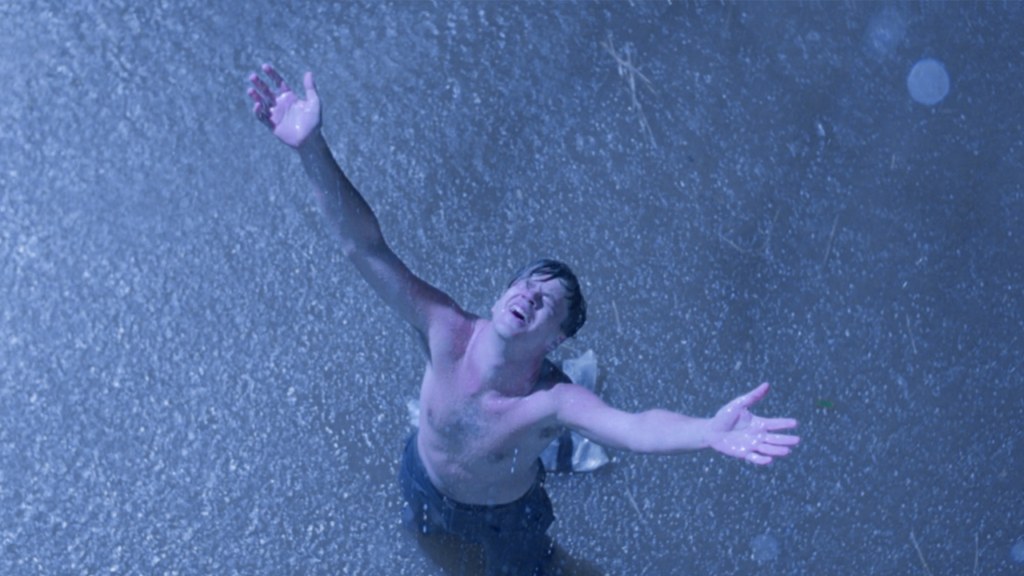
And eventually, after years of patience, determination, and hope, he emerges from the tunnel he spent decades digging. The image of him standing in the rain, arms raised to the sky, is one of the most powerful moments in cinema. The rain of liberation at the end of the tunnel, which began with Andy having hope.
By the end, after Andy has escaped, Red understands what Andy understood all along. He says, “Some birds aren’t meant to be caged. Their feathers are just too bright. And when they fly away, the part of you that knows it was a sin to lock them up does rejoice.”
And perhaps that is the simplest way to describe Andy Dufresne. Shawshank could imprison him, punish him, and try to break him. But it could never take away the one thing that truly mattered.
And that is why, more than thirty years later, The Shawshank Redemption continues to resonate all around. Because all of us, at some point in our lives, find ourselves facing our own version of Shawshank. A situation that feels impossible. A dream that seems too far away. A struggle that refuses to end. Hope that feels long lost.
And when that happens, the film leaves us with one final reminder, “Hope is a good thing, maybe the best of things. And no good thing ever dies.”
So, go on hoping.
Hope that you achieve your dreams. Hope that you’re the happiest once you do. Hope that success doesn’t change you. Hope that you find good people. Hope that your family and friends do well and stay happy. Hope that you never give up. Hope that you fight every battle, learn something from it, and come out the other end better, evolved, and wiser.
Hope.
Read More: