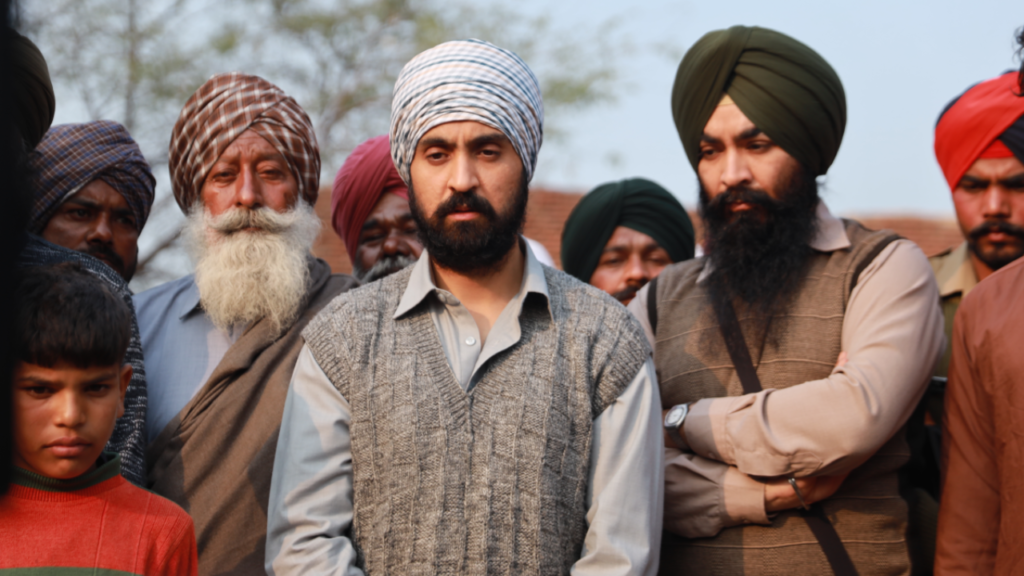
The film originally named Gallughara, written and directed by Honey Trehan, following the background and life of Jaswant Singh Khalra as he led the human rights movement in Punjab, was named so because, in Sikh history and terminology, Gallughara refers to a holocaust, a catastrophe, an existential tragedy, a calamity of immense proportions. By the meaning alone, you can guess why the name had to be changed.
Then it became Punjab ’95. But that title, too, had to be changed. This one, however, was changed by the filmmaker’s own choice, the reason remaining legal and administrative complications. Having not been granted certification under that title, releasing the film on OTT as Punjab ’95 would’ve meant stepping onto legally uncertain ground.
Then came Satluj. A subtle, simple, almost quiet name. The name of a river for a film that is anything but quiet. A film about the horrors committed by people in uniform under the guise of eliminating militants and terrorists. The name itself isn’t the problem, of course. The point is simply that it wasn’t a change born out of artistic choice. It was a change made necessary by forces outside the filmmaker’s control.
Satluj is a brave film. Not just because it was made, but because someone first dared to think of making it.
One of the darkest chapters in Punjab’s modern history unfolded during the years following the Punjab insurgency, which broadly lasted from the early 1980s until the mid-1990s. While the insurgency itself claimed thousands of lives through militant violence, assassinations, bombings and counter-insurgency operations, its closing years also saw serious allegations of police excesses, enforced disappearances and extrajudicial killings. By 1995, the police had, in many instances, accumulated extraordinary power in the name of restoring order. And somewhere along the way, for some of those entrusted with that power, the line between fighting terrorism and abusing authority blurred beyond recognition.
Power had, in many cases, become an end in itself. It had become vicious. Because what else do you call a public servant turned vigilante who no longer cares about the difference between a terrorist and an innocent civilian? What do you call someone who decides that suspicion is enough to justify death? There may be legal terms for it. But morally, “monster” doesn’t feel like an exaggeration.
And this is not the film’s account. This is the real account.
When the CBFC demanded 127 cuts, it quite understandably seemed unrealistic to the makers of the film. One hundred and twenty-seven cuts to a film is, for all practical purposes, stripping away its core. How do you protect the heart of a story when an external body asks you to remove it piece by piece? At what point does it stop being the same film altogether?
The makers, therefore, shifted their plans towards an OTT release. The film was legally entitled to release on a streaming platform. And yet, within 48 hours of its scheduled release, it was pulled back. Once again, the film found itself caught in uncertainty.
Having now watched the film myself, I’ve been searching for answers that could justify what happened to Satluj. A film that today is available in several countries outside India continues to hang in limbo in its own country. Maybe it will never receive a proper release here. Maybe someday it will.
But knowing what the film depicts, and then reading about the historical record that inspired it, I couldn’t quite arrive at a convincing reason for why a film like this should remain unavailable in a democratic India.
The film provides an unbending and truthful account of police brutality against innocent people. Above all else, it reminds us that humanity comes first, and that preserving it is the greatest responsibility of all. It also presents religion much like it exists in real life, capable of inspiring compassion, but equally capable of being distorted into something dangerous. Extremity has always driven people towards unimaginable horrors. And extremity does not belong to one side alone. It exists everywhere, on the right and the left, among believers and non-believers alike, whenever ideology begins to matter more than human life.
The film mainly follows Jaswant Singh Khalra, a man who became a beam of hope in the middle of overwhelming darkness. What first moved him was deeply personal. His friend was killed. So did his friend’s mother. She was later labelled “unclaimed” and cremated by the police without any meaningful investigation into what had happened to her. Most people would then deal with grief personally. But for Jaswant Singh, it became the beginning of a question.
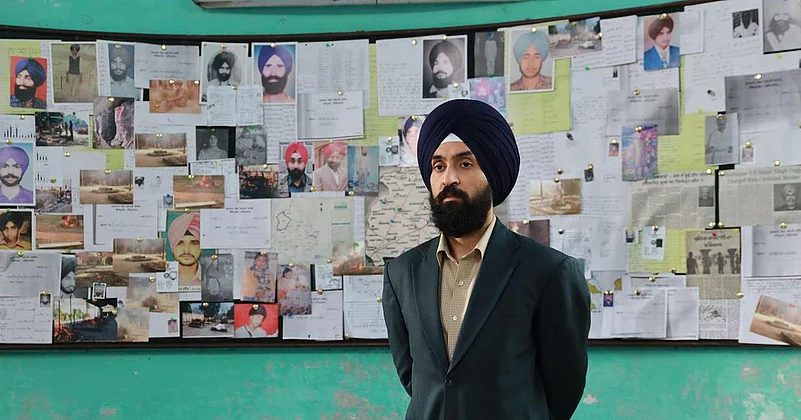
When he later discovered records suggesting that over 2,000 unidentified bodies had similarly been cremated as “unclaimed” across three cremation grounds in Amritsar, he saw something far bigger than numbers. Every one of those bodies belonged to someone. Every one of them had a family. Parents waiting for their son to return. Wives hoping their husband would walk through the door. Children who had no idea that the person they were waiting for had already been reduced to ashes without anyone even informing them or taking approval from them. He understood that ignoring his own suffering and simply moving on would do no good. It would only mean allowing injustice to continue unchecked, where human life had become something to be discarded, torn apart and thrown away as though it were nothing more than waste, instead of a living, breathing and dreaming person.
It is not ordinary to think and feel for thousands of people you’ve never met, and then fight for them as though they were your own family. As much as that should be normal, because empathy is not an alien feeling but a deeply human one, somewhere along the years it has become uncommon. Thinking beyond yourself is rare enough. Taking action for strangers is rarer still.
As Jaswant Singh became a human rights activist, he brought international attention to what was happening in Punjab. He documented the alleged illegal cremations, approached the courts, addressed human rights forums, and travelled abroad to speak about the issue. His work eventually reached Canada, where he was offered residence and protection for both himself and his family.
I think most of us would’ve accepted that offer without a second thought, knowing fully well what returning home would likely mean.
But he refused.
Because there was still work left to be done. Because he couldn’t accept that the answer to fear was abandoning his home and hiding from it. Because Punjab belonged to him and his family just as much as it belonged to anyone else. Because he knew he had committed no crime. Because, if anyone should have been running away and hiding, it was those responsible for the disappearance and killing of innocent people.
And what happened when he returned?
Exactly what everyone feared would happen.
On 6 September 1995, Jaswant Singh was abducted outside his home in Amritsar by Punjab Police personnel. He was illegally detained, repeatedly tortured, and pressured to withdraw his allegations. He never did. Days later, he was murdered. According to court findings, his body was disposed of by being thrown into the Harike canal, and it has never been recovered.
That was his fate.
Jaswant Singh Khalra was, in many ways, an ordinary man who became an extraordinary symbol. He valued humanity and kindness above all else. He inspired people not merely through speeches, but through action. He stood at the front when it was easier and far safer to remain silent. He demanded justice when almost everyone else was too afraid to ask the question. And most importantly, he reminded people that injustice does not become acceptable simply because it wears a uniform. It does not become lawful because politicians stand behind it. It does not become moral because it is done in the name of national security.
Jaswant Singh’s fight was never against the police as an institution. It was against impunity. Against the belief that power should exist without accountability. With the idea that not even one innocent life is an acceptable price to pay for eliminating fifty guilty people. Because if collateral damage becomes part of the plan from the very beginning, then it isn’t collateral damage anymore. What matters is that under no circumstances should anyone, from a police officer to a prime minister, have the right to decide themselves when it’s convenient to take a human life and when it’s not.
One quite logical argument that came from Honey Trehan was directed towards the people calling the film propaganda. His point was simple, even if the film truly is propaganda, then where is the harm in releasing it? There are countless films that carry propaganda of one kind or another. They are released, watched, debated and criticised. If Satluj is indeed propaganda, then let people watch it and decide for themselves. That, after all, is how free expression is supposed to work.
Yet.
The film is about our country. It is about accountability from the people who are supposed to function for the benefit of the people. That is a moral obligation. It is a duty that comes with wearing the uniform. The film asks for accountability where people in power have refused to provide it. It is about coming together as a country, standing against injustice and being unafraid in the face of it no matter what. It is about refusing to admit defeat until justice is served. It is about fighting against the very system that was built to protect you but had, instead, turned against you. A fight that you should never have had to fight. Nonetheless, a fight that needed to be fought.
The film never asks us to blindly hate the police. Nor does it ask us to worship Jaswant Singh Khalra as someone incapable of fear. It simply asks us to remember that institutions are made up of people. Some abuse power. Some stand against that abuse. And if we stop questioning those in power simply because they represent the State, then justice becomes conditional. It becomes something granted by authority rather than something guaranteed by law.
Democracies are not tested by how they treat those who agree with the system. They are tested by how they respond to criticism, to uncomfortable truths, to stories that question authority instead of celebrating it. If a film cannot be watched because it raises difficult questions about the State, then the conversation slowly shifts away from the film itself. It becomes about whether we are comfortable confronting our own history.
The irony is that Satluj isn’t asking us to hate our country. Quite the opposite. It asks us to care about it enough to demand better from it. Because accountability is not anti-national. Questioning power is not anti-national. Seeking justice for innocent people is not anti-national. If anything, these are the very things that strengthen a democracy rather than weaken it.
Jaswant Singh Khalra understood something many of us often forget. A country is not defined by its governments. Governments change. Uniforms change. Political parties change. What remains are its people. And when those people lose the courage to ask questions, history has a habit of repeating itself.
Maybe that’s why Satluj feels so important. Not because it tells a perfect story. Not because it claims to have every answer. But because it refuses to look away. And that’s exactly what makes it such a difficult film to release.
Watch Film ‘Satluj’ Trailer:
Read More:
- Hollywood Box Office Failures 2025 Explained — What The Year’s Biggest Misses Taught Us
- From Water to Fire: How Avatar’s Visual Language Is Evolving
- Why James Cameron’s Films Refuse to Fade — Even When the Box Office Is Done
- Best Santa Claus Movies of All Time, Ranked by Impact and Legacy
- When Beauty Becomes a Prison: The Eternal Relevance of Jalsaghar