Toaster reviews have arrived with a sharply divided response, placing the Rajkummar Rao and Sanya Malhotra starrer in that familiar space where a strong concept meets inconsistent execution. Positioned as a dark comedy thriller, the film has sparked reactions that range from outright dismissal to mild appreciation, with critics agreeing on one thing — the idea is compelling, but the film around it doesn’t always hold together.
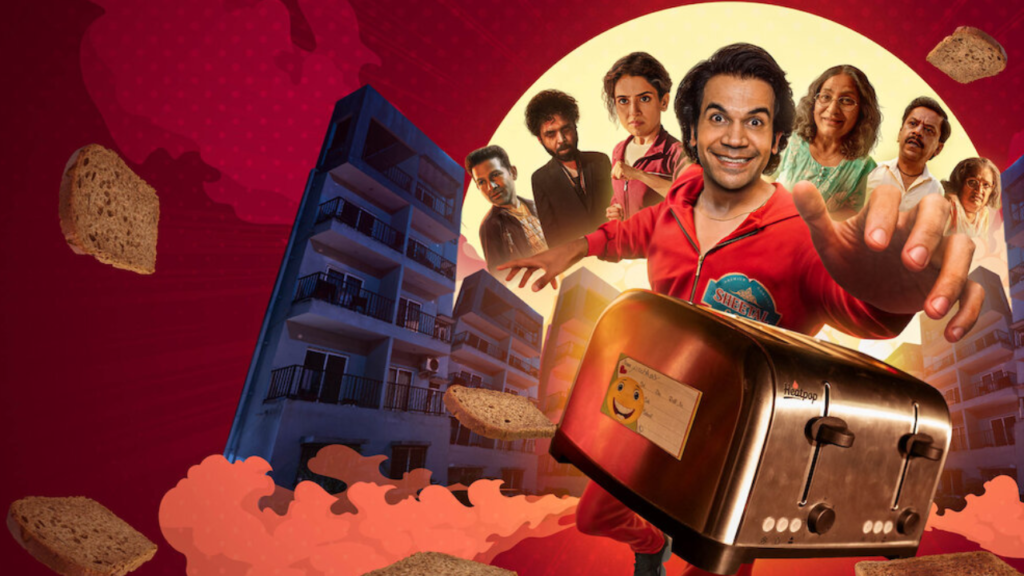
Directed by Vivek Daschaudary, Toaster follows Ramakant, a miserly man whose obsession with retrieving an expensive toaster gifted at a cancelled wedding spirals into a chain of bizarre and increasingly dangerous events. What begins as a simple, almost absurd premise gradually expands into a chaotic narrative involving crime, deception, and a gallery of eccentric characters. The film attempts to blend situational humor with thriller elements, situating itself within the growing space of Indian dark comedies that aim to extract satire from everyday middle-class anxieties.
View this post on Instagram
The most polarizing aspect of Toaster lies in how differently critics have responded to its humor. On one end of the spectrum, the film has faced strong criticism for failing to deliver on its comedic promise. A sharply negative take from Koimoi describes it as “an unnecessary, no-humor comedy film,” going as far as to say, “I would not waste any butter on it.” This line has come to define the harshest reactions to the film, where the humor is seen not just as ineffective, but actively grating. For these critics, the film’s attempts at quirkiness quickly descend into chaos without payoff, turning what should have been dark comedy into something closer to irritation.
Yet this is only one side of the conversation. A more balanced critical perspective acknowledges that while the humor does land in parts, it struggles to sustain itself across the runtime. The Hindu notes that the film “delivers on the laughs even when the writing remains largely perfunctory” , pointing to a screenplay that leans heavily on situational gags without building a strong narrative foundation beneath them. Similarly, Hindustan Times observes that “sparks fly, but the heat doesn’t last” — a concise way of capturing the film’s trajectory from an engaging setup to a gradually diminishing payoff.
This pattern — a strong beginning followed by a weakening second half — appears consistently across reviews. Critics note that the film opens with energy and a clear sense of comic timing, but begins to lose momentum as the narrative stretches itself too thin. What initially feels like controlled chaos slowly turns repetitive, with jokes lingering longer than they should and plot developments failing to escalate meaningfully. By the time the film reaches its final act, the sense of unpredictability that once fueled it gives way to narrative fatigue.
Still, there are critics who find value in the film’s eccentricity and tone. Scroll.in offers a more positive reading, calling it “generous with the laughs,” suggesting that its absurdity works if one is willing to embrace its anything-goes approach. Similarly, Film Companion describes Toaster as “a consistently watchable crime comedy” , highlighting its ability to remain engaging even when it leans into familiar genre beats. These responses indicate that for a certain audience, the film’s exaggerated world and relentless absurdity are part of its appeal rather than its weakness.
Across all these perspectives, one area where critics largely converge is in their assessment of performances. Rajkummar Rao remains the film’s central strength, with multiple reviews noting his ability to keep the narrative afloat even when the writing falters. Hindustan Times points out that “there’s an inherent watchability to him” , a quality that ensures the character remains engaging despite the film’s structural issues. Rao’s portrayal of Ramakant — a man defined by his obsessive frugality — taps into a familiar comedic space he has explored before, though some critics argue that the role feels like an extension of characters he has already played, rather than a reinvention.
Sanya Malhotra, on the other hand, receives a more subdued response. While she brings sincerity to her role, critics frequently note that the character itself is underwritten, limiting her impact on the overall narrative. The Hindu observes that she “doesn’t get much to do” , a sentiment echoed across multiple reviews that see her as a supporting presence rather than a fully realized co-lead. The supporting cast, including Archana Puran Singh and Abhishek Banerjee, adds to the film’s eccentric tone, though their effectiveness varies depending on how well the humor lands for individual viewers.
Ultimately, the central issue with Toaster lies in its screenplay — a point that critics return to repeatedly. While the premise is widely seen as inventive, the writing struggles to develop it into a cohesive narrative. The humor, though occasionally effective, often feels disconnected from a larger thematic or emotional arc. As a result, the film oscillates between moments of genuine amusement and stretches of repetition, never quite finding a balance that sustains its momentum.
And yet, despite these shortcomings, Toaster is not entirely dismissed. There is a consistent acknowledgment that the film is attempting something different within the Bollywood comedy space — a genre that has historically struggled to balance dark humor with mainstream sensibilities. Its willingness to embrace absurdity and push a trivial premise into extreme territory reflects a creative ambition that critics recognize, even when they question the outcome.
In the end, Toaster lands as a film that is easier to admire in concept than in execution. It offers flashes of humor, a committed central performance, and a premise that stands out in an increasingly crowded OTT landscape. But it is ultimately held back by a screenplay that cannot fully support its own ideas. For some, it will be an enjoyably chaotic ride; for others, it may feel like a joke stretched too far.
Cast: Rajkummar Rao, Sanya Malhotra, Archana Puran Singh, Abhishek Banerjee
Director: Vivek Daschaudary
Genre: Dark comedy, thriller
Platform: Netflix
Read More Review Roundups on POF