“What you seek is seeking you,” is a famous quote by the 13th-century Persian poet and Sufi mystic Jalaluddin Rumi, but today’s generation remembers it from an Imtiaz Ali film. It’s a matter of faith, an intangible thing, but it gives you something to believe in. We spend our entire lives trying to find purpose. Films being an innate part of our lives, allow us to question this through them and reflect on what films do to us as individuals. But like how every fruit is not the same, some of us might be looking to find ourselves others are simply hoping to escape.
When I was a kid, I used to long for somewhere I could go where the real world wouldn’t seem so harsh or just that real. I’m sure all of us have at some point wondered the same thing, whether after a scolding from our parents or after getting terrible marks in tests and the teacher screaming your score or right before going on stage for a recitation. Right when you probably badly wanted to space jump into another hemisphere, there are films, waiting to take you to the land of the unknown. showing us what films do to us in moments when reality feels overwhelming.
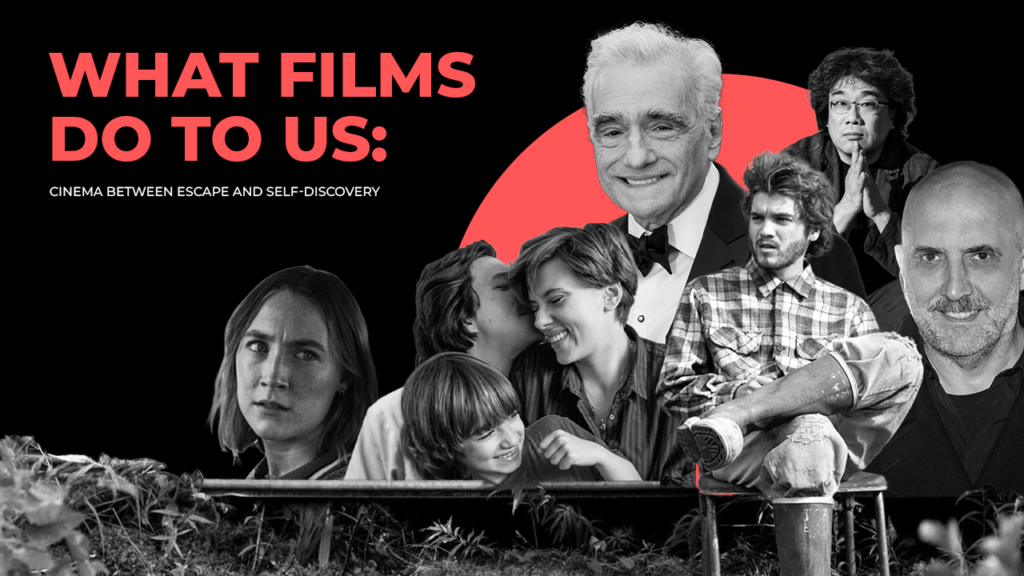
The personal nature of filmmaking is what makes films most engaging, leaving room for the search of truth within oneself. While receiving an Oscar for the film Parasite, Bong Joon-ho quoted a famous saying of Martin Scorsese: “The most personal is the most creative.” It’s not necessary that a film inspired by a personal event will connect only with the person that that film is based off of because it’s their life; rather, such are the films that resonate with a wider audience. Whether this is because one can sense the filmmaker’s investment in every frame, or some other reason relating only to the individual, can be up for speculation.
Noah Baumbach, Writer-Director, once recalled a saying by Philip Roth, the American novelist, that he always started by taking two stones of reality and rubbing them together to spark the imagination. Many films, while not strictly autobiographical, are often cited as blending elements of personal life with fiction. Films like Lady Bird, Marriage Story are great examples of such pieces of art, where the filmmaker openly accepts them as being inspired by their own life. “You’re always making something that’s away from you but part of you,” said Greta Gerwig.
Martin Scorsese said, “You can’t make a vocation your calling because you want to be like somebody; you have to find your own.” While Scorsese said it in a completely different connotation, pertaining to his personal life, it also remains true for other things in life, such as the path you choose to walk on. It’s paramount to remember that every story is different, every journey unlike another. While we can find some wonderful things from a film, it’s also important to remember the distinction between a character and a human being. especially when considering what films do to us and how deeply they can influence perception. Because if films can give us a sense of direction, it can also distract us, and it’s on us to figure out what’s distraction and what’s not.
What is deemed as positive and negative is very different for every person. Known for its blatant, raw and dense filmmaking style, Irreversible is a brutally intense film, the camera never shying away from the portrayal of rape on screen, which is also construed as controversial due to the gut-wrenching, graphic visuals of the same. Then there’s the film Into The Wild. This is a film that can be regarded as an escape, but also as a discovery of identity by some. The cinematography feels larger than life, enthralling in each shot, on the other hand, there’s the idea of a boy choosing to donate all his money to live in the wilderness and find himself.
The life of a tired corporate employee will be contrasting to that of a cinephile. The British Director and Producer Danny Boyle said, “Ordinary people at the end of a tough week just want to go and lose themselves in some extraordinary idea or image or creation.” However, a cinephile craves for every film to be different, films having nuance, even remakes are appreciated when made while bringing a unique perspective to the table. A book lover like myself finds films based on adaptations extremely attractive. Then there’s also an activist who would appreciate films that hold a mirror to society covering real problems happening in the world in a responsible manner. Since every person is inherently different, this can also be observed in their distinctive choices of the films they choose to watch.
Films are used as a form to centre oneself in life. The main theme of films that are about discovering oneself has the power to move you in unfathomable ways. If you look at the history of films, right from the silent era to now, films from around the world, I’m sure you’ll find relatability for every human. And if there are still a few concepts left unrepresented, those films are probably under production as we speak.
Just as filmmakers hold the freedom to craft films however they choose, film viewers hold the very same freedom to watch films for whatever reasons they choose.
Read More:
- How much does responsibility seep into filmmaking? Or does it at all?
- When Beauty Becomes a Prison: The Eternal Relevance of Jalsaghar
- Roger Corman: The King of Cult Cinema and His Enduring Legacy