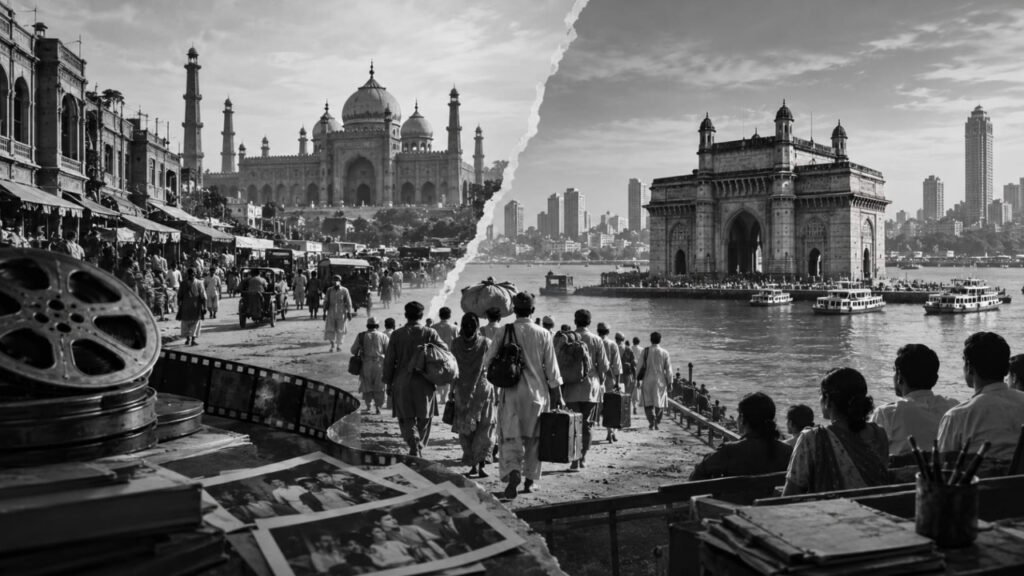
Before Partition, Indian cinema did not really know what a border was.
The film industry moved between Bombay and Lahore, and so did the people who made it. Actors, writers, musicians, directors and technicians could work in both places. There was no separate “Indian” or “Pakistani” cinema yet, because there was no India and Pakistan as we know them today. There was simply a larger cultural space where stories, languages, and people travelled freely.
Lahore had become one of the important centres of filmmaking in Northern India, while Bombay was rapidly growing into another major film hub. Films were made in Hindustani, which naturally brought Hindi and Urdu together, along with Punjabi. The stories were not necessarily concerned with where a person belonged religiously. Romance, mythology, folk stories, and social dramas could travel from one place to another and find an audience.
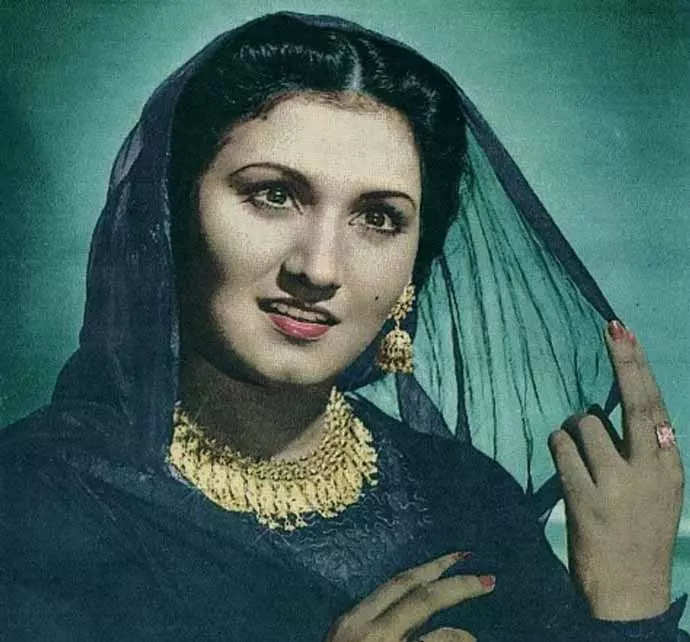
People who would later be separated by a border were working together before there was one. Noor Jehan worked in Hindi films in Bombay. Saadat Hasan Manto wrote for films there. Zia Sarhadi moved between Lahore and Bombay. The stories too were not necessarily concerned with where one person’s home ended and another person’s began. There were romances, social dramas, folk stories, and mythological films. Cinema was looking at people and their lives, and the market itself was larger than any one region.
And then partition happened.
For the film industry, this was not simply a change in the map. It meant that the people who made cinema were suddenly being forced to decide where they could live and work. Some Muslim artists left for the newly created Pakistan, while many others stayed in India. At the same time, Hindu filmmakers and other members of the industry who had been working in Lahore came to India. Studios were damaged in the violence, people were displaced, and professional relationships that had existed for years were suddenly broken.
The film industry did not stop as a result, however.
Bombay, Calcutta, and Madras continued to function as important centres of filmmaking. In that sense, Indian cinema survived the immediate shock of partition more easily than the country itself did. But surviving does not mean remaining unchanged. The people inside the industry had changed. The society they were making films for had changed. And slowly, the things cinema looked at began to change as well.
One of the biggest changes was in what could be shown and, more importantly, what could be spoken about.
Partition had left behind millions of displaced people, broken families, violence, and the loss of homes. Yet Indian cinema did not immediately turn this trauma into films. There was a silence around partition in the first few years. The country was newly independent and was trying to build itself as one nation. There was also the trauma of having just lived through such unimaginable violence. It is difficult to turn something into a story when people are still trying to live through its consequences.
But the subject did eventually find its way into cinema.
And when it did, filmmakers were not only interested in the violence itself. They were interested in what came after it. What happens to a person who has lost their home? What does displacement do to a family? What happens when the place you grew up calling home suddenly belongs to another country?

This is where the film Chinnamul (1950) becomes interesting. Directed by Nemai Ghosh, the film is one of the earliest films to deal directly with partition and its aftermath. What makes it significant is not just what it tells us, but how it tells the story. It follows displaced people and shows their hunger, poverty, relocation, and the uncertainty of beginning their lives again. It used non-professional actors, including people who had actually experienced displacement, and was shot on real streets, refugee camps, and around Sealdah station. Some of the filming was done with hidden cameras because of the difficulties involved in shooting there.
That changes the way the film feels. The camera is no longer looking at a polished version of life. It is looking at people who are living through something. The refugee is not an idea in the background of the story. The refugee becomes the person we are watching.
Even the train begins to mean something different post partition.
Before partition, trains in Indian cinema could carry the excitement of movement, travel, and a modernising country. After partition, the train could also mean leaving. It could mean separation. It could carry people who no longer knew where they were going to live. In Chinnamul, the crowded trains and the faces at the station become part of the film’s emotional landscape. The horror does not always have to be shown through bloodshed. Sometimes a face carrying everything it owns is enough.
And this was also a change in filmmaking itself.
Partition gave filmmakers a reason to move outside the studio and look at real spaces. It made location, faces, and everyday details more important. It pushed cinema towards a kind of realism where poverty did not have to be beautified and displacement did not have to be turned into melodrama. The limitations of making a film under those circumstances became part of its visual language.

Ritwik Ghatak was one such filmmaker who took this further. He was deeply affected by the division of Bengal, and that personal connection can be felt throughout his filmography. His cinema is full of people who have been uprooted but have not emotionally left the place they came from. In Meghe Dhaka Tara (1960), Komal Gandhar (1961), and Subarnarekha (1965), partition is not always presented as one historical event that happened and ended. It continues to live inside the characters.
In Meghe Dhaka Tara, we see a refugee family trying to survive in Calcutta. There is unemployment, financial pressure, and the constant struggle to rebuild a life. But beneath all of that is the feeling that something has already been lost. The family may have found another place to live, but that does not mean they have found home again.
This is also where Ghatak’s filmmaking becomes important. He did not only tell these stories through dialogue. Sound became a major part of his cinema. A sound could contradict what we were seeing. A close-up could hold an emotion longer than a conversation could. He combined melodrama, theatre, and traditional storytelling with deep-focus photography and unusual sound design. His films could look theatrical and realistic at the same time.
And maybe that is one of the most interesting things partition did to Indian filmmaking. It did not create one new style. It created a new emotional territory.
Filmmakers were now dealing with memory, displacement, identity, and the feeling of belonging to a place that no longer existed in the same way. Women also became an important part of these stories because partition had exposed them to extraordinary levels of violence and vulnerability. Later films would return to this through characters who were abducted, separated from families, forced to migrate or left to rebuild their lives after unimaginable experiences.
But Indian cinema did not remain fixed in the immediate aftermath of partition.

As decades passed, the way filmmakers approached it changed. The early films were often closer to the experience of displacement itself. Later films began to look at partition through memory, politics, and the relationship between India and Pakistan. Films such as Garm Hava (1974), Tamas (1988), Train to Pakistan (1998), 1947 Earth (1998), and Pinjar (2003) revisited the period from different perspectives.
And the distance of time changed the filmmaking too.
A filmmaker making a partition film in the 1950s was dealing with something that was still painfully close. A filmmaker making one decades later could look back at it. The question was no longer only, “What happened?” It could also be, “What did this event do to us?” and “Why are we still carrying it?”
That is why partition has remained in Indian cinema for so long. It has moved from being an event to being a memory, and memory is something that lingers on forever.
Even the representation of the other side changed with time. Some Indian films presented Pakistan through hostility and nationalism, while others tried to imagine relationships that could exist beyond the border. Veer-Zaara (2004), for instance, used the India-Pakistan divide as the obstacle in a love story rather than simply as the setting for political conflict.
So when we ask how filmmaking changed before and after partition, the answer is not simply that filmmakers started making films about partition.
The bigger change was in what Indian cinema had begun to understand about its own people.
Before 1947, filmmakers could move between cities that would soon belong to different countries. Their actors, writers, and musicians worked together without the border that would later separate them. After partition, that movement became a memory. The industry continued, but the world it was documenting had been fractured.
And cinema had to learn how to frame that fracture.
It began looking at the refugee, the abandoned home, the crowded train, the woman trying to survive, the family trying to restart. It began using real locations and unfamiliar faces. It began allowing silence, memory, and sound to carry things that dialogue could not.
Because partition did not just change where people lived. It changed what home meant. And once that changed, the way Indian filmmakers looked at people, places, and stories could not remain exactly the same as it once did.
Read More: